Home / History

A canyon, a rope, and 137 years of crossing it.

From a single hemp-and-cedar span tied off by a Scottish engineer in 1889 to a seven-attraction park welcoming over a million guests each year — this is how the bridge endured.

The land north of Vancouver's harbour belonged — and belongs still — to the Skwxwú7mesh (Squamish) and səlilwətaɬ (Tsleil-Waututh) peoples. Long before the bridge, the canyon was a place of stories. The first crossing changed how strangers came to this place, but the land's deeper history continues underneath every plank we step on.

What follows is a timeline of the bridge — six owners, a rebuild in five days, and a park that grew up around an old rope.

1888 – 1935

The first crossing, and what came after.

George Grant Mackay arrived in Vancouver in 1888 with civil-engineering credentials and a romantic streak. Within a year, a rope was strung across the canyon.

1888

George Grant Mackay arrives.

A Scottish-born civil engineer, Mackay buys 6,000 acres of forest along the Capilano River and builds himself a small cliffside cabin near the canyon edge. The forest is dense, the river loud, and there is no easy way across.

1889

A bridge of hemp and cedar.

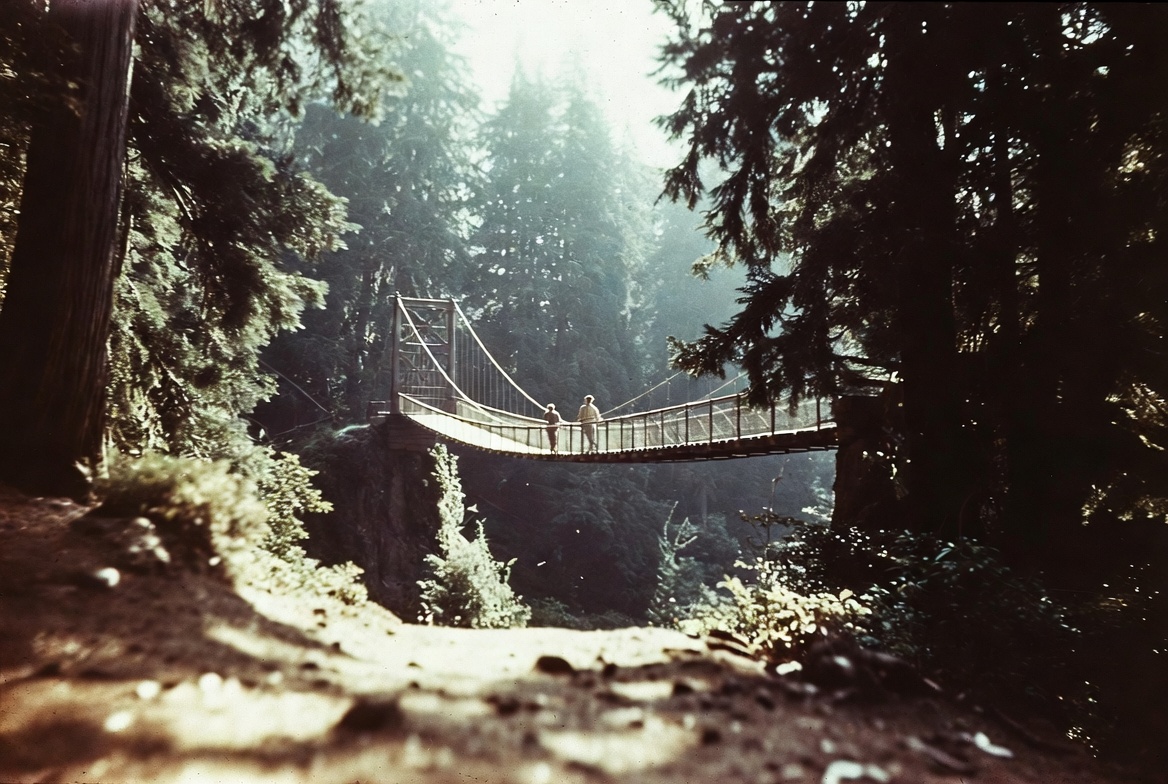
Mackay strings the first suspension bridge across the canyon — hemp ropes, cedar planks. Two horses are said to have swum the cables across the river under the guidance of August Jack Khahtsahlano, of the Squamish Nation. Friends crossed it. So did anyone curious enough to walk the trail.

1893

A name for the visitors.

Mackay has died, but the bridge has not. Locals begin trekking out from town on weekends to walk it. They are nicknamed the "Capilano Tramps" — the first park-goers, before the park existed.

1903

Hemp gives way to wire.

The original ropes are replaced with steel cables. The bridge stops swaying quite so violently. It carries more visitors than the founder ever imagined.

1911

Edward Mahon and the Tea House.

Mahon, an Irish prospector who had made his name in the Klondike, takes ownership of the property. He builds a Tea House at the canyon's edge — the first hospitality on site — and in 1914 reinforces the bridge with additional cables.

1935

"Mac" MacEachran & the totems.

A former forest ranger, MacEachran takes over and invites carvers from the Squamish, Kwakwa̱ka̱ʼwakw, and other Pacific Northwest nations to install totem poles around the property. Many of them still stand at Kia'palano today.

1945 – 1983

Rebuilt in five days.

By the postwar years, the property had become a tourist destination. The bridge had been rebuilt once. It would be rebuilt again — this time in less than a week.

1945

Henri Aubeneau takes over.

A French-born hotelier, Aubeneau buys the property from MacEachran. The park's hospitality side begins to develop — gift shops, refreshments, more visitors arriving by car.

1953

Rae Mitchell — the modern showman.

Mitchell purchases the park and aggressively promotes it to international travel agents and cruise lines. The Capilano Bridge becomes a fixture on the Vancouver itinerary — almost no foreign visitor leaves without crossing it.

1956

A bridge rebuilt in five days.

In one of the more remarkable feats of engineering improvisation in BC history, Mitchell's crew reconstructs the entire bridge in five days, anchoring the cables in 13 tons of fresh concrete on each side. It is the same bridge guests cross today — wider, stronger, but suspended on the same arc through the canyon.

1983

Nancy Stibbard inherits the park.

Mitchell's daughter takes over operations. Over the next decade she elevates the park into what the Canadian Tourism Hall of Fame would describe in 2000 as a "world-class destination." She is still its CEO.

2004 – present

Seven attractions, one rainforest.

Under Stibbard, the park has expanded outward — not so much in acreage as in altitude. Up the trees, along the cliffs, and into the canopy.

2004

Treetops Adventure opens.

Seven mini-bridges weave between Douglas fir trunks 30 metres up — a forest-canopy walk built without driving a single bolt into a living tree. Engineered with collars that flex as the trees grow.

2005

Canyon Lights begins.

A modest first-year display becomes, year after year, the largest winter light installation on the North Shore — eventually two million bulbs, draped through the canyon for the entire holiday season.

2011

Cliffwalk opens.

A cantilevered walkway clings to the granite face of the canyon — 213 metres long, suspended up to 90 metres above the river. Glass underfoot in places. No swaying.

2014

The Capilano Group expands.

Stibbard adds Stanley Park properties — Prospect Point, the Stanley Park Pavilion — to the family of operations. The bridge remains the company's flagship.

Today

Same canyon, same arc.

Over a million guests cross the bridge each year. The original posts have been replaced more than once. The cables are checked annually. The arc through the canyon is the same one Mackay's hemp-and-cedar bridge described in 1889.

A note on the land

Older than 1889, longer than memory.

The Capilano River runs through unceded territory of the Skwxwú7mesh Úxwumixw (Squamish Nation), səlilwətaɬ (Tsleil-Waututh Nation), and xʷməθkʷəy̓əm (Musqueam Nation). The Kia'palano section of the park, in collaboration with First Nations carvers and storytellers, exists to honour that older history. We acknowledge that everything we do here happens on land that was — and is — already known and storied.

Visit Kia'palano →